


Views: 0 Author: Site Editor Publish Time: 2026-10-13 Origin: Site


Choosing the wrong heavy machinery can severely cripple your project profitability. Drilling contractors face a constant operational tug-of-war. You must balance the raw off-road power required for remote sites with the fast highway mobility needed for urban jobs. Misjudge your primary terrain, and you risk hemorrhaging money on logistical nightmares. Worse, your crew might end up stranded in deep mud.
We will break down the critical operational differences between track-based and wheeled platforms. By evaluating mobility, setup times, hidden logistical costs, and environmental footprints, you will learn how to select the optimal mobile borehole drilling machine tailored specifically to your business model and local geography.
Terrain is King: Track-based machinery is unmatched for rugged, muddy, and uneven landscapes. Wheeled configurations excel on flat, easily accessible ground.
Mobility vs. Setup: Truck-mounted units offer rapid highway travel and lightning-fast setup times. This drastically reduces transit costs and minimizes downtime between jobs.
Transportation Logistics: Tracked rigs demand an additional transport trailer and a heavy-duty towing vehicle. Moving from site to site heavily impacts your overall operational expenditure.
Footprint and Accessibility: Tracked machines generally boast a more compact operational footprint. Operators can squeeze into tight residential backyards or heavily wooded lots.
Return on Investment Depends on the Niche: Your equipment choice must align directly with your most frequent project types, local geological conditions, and long-term capital constraints.
To make a truly informed purchasing decision, one must first grasp the basic architecture of contemporary drilling equipment. At their core, these machines are highly complex assemblies engineered to penetrate the earth crust. Primary components typically include a reinforced mast, robust hydraulic systems for lifting and pulldown forces, and mud pumps designed for clearing abrasive cuttings. The rotational force is usually delivered by a rotary table drive or a mechanical power head.
Historically, early drilling equipment was largely stationary. Exhausting setup and teardown times ate into profit margins. The industry has evolved dramatically to meet the demands of modern contractors who prioritize efficiency. This evolution led to the development of highly integrated, self-contained systems mounted on movable bases.
Looking at current industry trends, we see a distinct polarization in rig procurement driven by macroeconomic factors. As urban sprawl pushes residential development outward, contractors are increasingly favoring wheeled configurations. The demand for rapid deployment across paved infrastructure is at an all-time high. Conversely, the global push for renewable energy has triggered a massive spike in deep geothermal heat pump installations. This green energy boom, combined with off-grid agricultural needs, has solidified the tracked rig dominance in sectors where raw terrain accessibility dictates whether a project even starts. The primary differentiator in today market is the undercarriage design.
A crawler water well drilling rig utilizes a heavy-duty track-based undercarriage system. It looks and functions much like an excavator base. This rugged design mounts the drilling mast, diesel engine, and hydraulic components onto a steel frame. Continuous tracks support the entire structure. These tracks can be outfitted with either reinforced steel pads or durable rubber treads.
Unmatched Off-Road Capability: The most profound advantage of a crawler system lies in its weight distribution. Tracks spread the immense, concentrated weight of the drilling equipment over a vastly larger surface area compared to standard tires. This significantly lowers the ground bearing pressure. You can navigate a muddy agricultural field after heavy spring rains without sinking. Pushing through loose coastal sand becomes routine rather than a rescue mission.
Gradeability: Engineered for extreme environments, crawlers possess superior gradeability. They safely scale steep inclines and navigate uneven mountainous terrains. The terrifying risk of tipping or losing traction is greatly reduced. For off-grid locations, this climbing capability is absolutely indispensable.
Compact Footprint: The tracks integrate tightly into the chassis. Therefore, crawler rigs often feature a shorter overall length and a zero-turn pivoting radius. Drillers can maneuver into tight residential backyards or thread through narrow fence gates. Setting up in dense forests where a standard commercial truck would be completely blocked is a major selling point.
Slow Travel Speed: The inevitable trade-off for exceptional off-road traction is speed. Crawler rigs move at a sluggish walking pace when on-site. They typically crawl between one to three miles per hour. Furthermore, local laws strictly prohibit driving them on public roads.
Logistical Overhead: Crawler rigs lack highway mobility. Deploying them requires a separate flatbed lowboy trailer and a heavy-duty semi-truck. This multi-vehicle setup adds a thick layer of logistical complexity. It also demands higher capital expenditure if you do not already own a transport fleet.
Tracked rigs are the undisputed champions for contractors operating in rocky mountainous regions and soft-soil agricultural belts. They dominate remote off-grid properties and swampy environments where traditional wheeled vehicles would instantly become stranded.
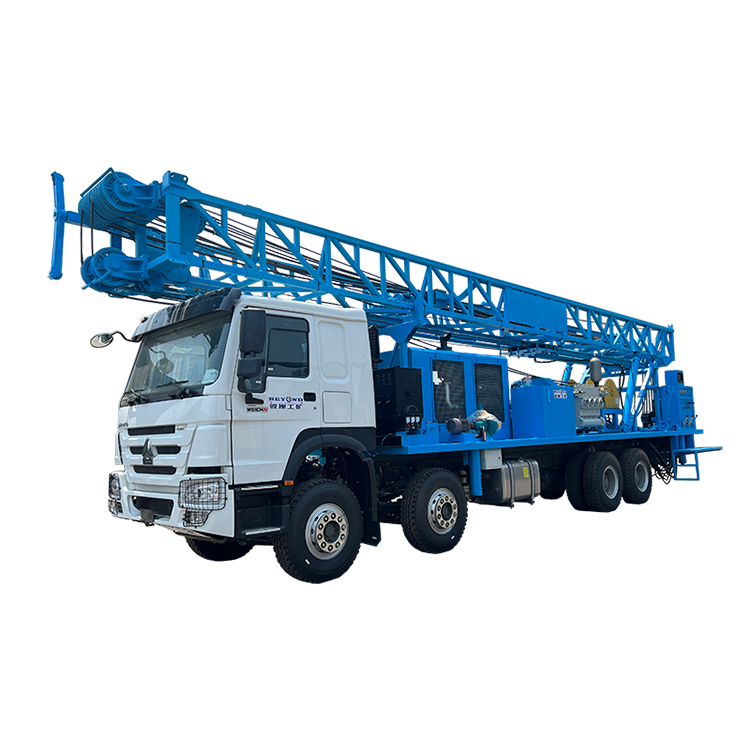
A truck mounted well drilling machine merges the drilling mast, power unit, and hydraulic systems directly onto a commercial truck chassis. Depending on the anticipated drilling depth and payload requirements, manufacturers configure these platforms as rugged commercial vehicles with multiple drive axles.
Highway Speed and Rapid Deployment: The defining benefit of a truck-mounted rig is its autonomous roadworthiness. Operators fire up the engine at the equipment yard and merge directly onto the highway. Cruising at standard traffic speeds drastically slashes transit times. Ambitious contractors can potentially complete multiple shallow residential wells in a single workday.
All-in-One Convenience: Many modern wheeled setups utilize a power take-off system. The truck primary diesel engine powers both the vehicle drivetrain on the road and the hydraulic drilling components once parked. Eliminating a secondary deck engine helps the rig shed excess weight. This design also simplifies overall machinery maintenance.
Lower Transportation Costs: The rig serves as its own transport vehicle. Business owners save thousands annually on the logistical costs associated with maintaining flatbed trailers and hiring escort vehicles. You also stop burning the extra diesel required to haul heavy crawler equipment.
Terrain Limitations: Commercial trucks are incredibly heavy. They rely on tires that concentrate the vehicle entire mass into small contact patches. Consequently, truck-mounted rigs easily bog down in mud, deep sand, or saturated soil. Picture driving a massive truck across a soft manicured lawn. The resulting deep ruts will infuriate the property owner and cost you landscaping fees.
Larger Turning Radius: Trucks inherently require a wide turning radius. Maneuvering a massive chassis into confined urban spaces or narrow alleys is an exercise in frustration. Lots obstructed by mature trees often require extensive site clearing before drilling can even commence.
Wheeled rigs are highly recommended for urban and suburban water well drilling. They excel in industrial site access and flat rural areas with solid ground. Business models that thrive on high-volume, rapid site-to-site transitions rely heavily on this platform.
To assist buyers in visualizing their options, we have compiled a core comparison matrix. This breakdown highlights the day-to-day operational differences between the two rig architectures.
Feature | Crawler Drilling Rig | Truck Mounted Drilling Rig |
|---|---|---|
Mobility | Off-road only. Requires transport trailer. | Highway legal. Drives directly to the site. |
Setup Time | Slower. Requires unloading and tramming. | Lightning-fast. Park, level, and drill. |
Terrain Capability | Exceptional in mud, sand, and steep grades. | Limited to solid ground and paved access. |
Operational Footprint | Compact with zero-turn capability. | Large, requiring a wide turning radius. |
Logistical Costs | High due to trailer and tow truck needs. | Low, as it transports itself. |
Ground Damage | Low ground pressure prevents sinking. | High risk of deep rutting on soft turf. |
When evaluating actual penetration rates, both platforms are highly capable. Drilling depth is primarily dictated by the mast structural integrity and the pullback force of the hydraulic cylinders. Torque generated by the rotary head also plays a massive role. Both styles tackle shallow residential wells or deep industrial boreholes. However, crawler rigs inherently provide a more stable, lower center of gravity during deep, high-torque drilling operations. Truck rigs rely entirely on the precise deployment of hydraulic leveling outriggers to prevent tipping.
From a purely logistical standpoint, truck-mounted rigs excel in setup speed. Once backed into position, the operator simply drops the hydraulic leveling jacks to stabilize the chassis. You can immediately raise the mast. In contrast, deploying a crawler rig is a multi-step process. You must unload it from the lowboy trailer, tram it slowly across the property to the exact drilling spot, and then level the unit. Tracks offer incredible inherent stability, but the time from arriving at the curb to actually turning the drill bit is noticeably longer.
Ground pressure plays a major role in a contractor environmental footprint. Tracks gently disperse weight, resulting in minimal deep rutting on soft earth. However, pivoting a steel-tracked crawler sharply in place will instantly shred topsoil and grass. Tires concentrate weight into small areas. They carry a much higher risk of soil compaction and creating deep trenches. This often requires costly landscaping remediation after the well is cased.
Making a purchasing decision requires a comprehensive look at both capital expenditure and operational expenditure. The true cost of heavy machinery extends far beyond the initial sticker price.
Buyers often notice a distinct pricing structure upfront. A standalone crawler rig generally presents a lower initial acquisition cost for the drilling unit itself. You are primarily purchasing the mast, undercarriage, and hydraulics. Conversely, a truck-mounted machine commands a premium price tag. That purchase includes a heavy-duty, road-legal commercial truck chassis integrated directly with the drilling apparatus.
The most significant financial blind spot involves transportation logistics. Purchasing a crawler rig is rarely a standalone investment. If your company lacks a heavy-duty transport truck and a specialized lowboy trailer capable of hauling massive loads, you must add these to your initial budget. Factor in the extra fuel, trailer maintenance, and the potential need for a dedicated transport driver. The total acquisition and running cost of a crawler operation often eclipses that of a truck-mounted setup.
Maintenance budgets differ drastically based on the mobility platform. Tracked undercarriages require meticulous, gritty maintenance. The steel tracks, rollers, idlers, and hydraulic tramming motors endure immense stress, especially in abrasive environments containing quartz sand. Replacing a worn undercarriage is a major expense. Alternatively, truck-mounted systems bypass track wear but introduce strict commercial vehicle maintenance. You must account for highway tires, transmission servicing, transport department inspections, commercial auto insurance premiums, and jurisdictional road taxes.
Audit your specific operational environment before finalizing your equipment procurement. Use the following criteria to align your purchase with your daily reality.
Geography dictates equipment selection. Analyze the terrain where the vast majority of your jobs take place. Are you drilling in the rocky terrains of mountainous regions or the muddy plains of agricultural belts? Or are your sites mostly paved, easily accessible urban developments? A wheeled rig in a swamp will cost you thousands in emergency towing fees. A crawler rig in a dense city will bleed your margins dry through wasted transport time.
The depth, diameter, and application of your average borehole must match the rig capabilities. Geothermal loop drilling often requires maneuvering around existing residential structures and sensitive landscaping. This makes the compact footprint of a rubber-tracked crawler highly desirable. Open-field agricultural drilling often benefits from the heavy payload capacity of a large truck chassis. Crews can carry extra drill pipes, casing, and water directly onboard.
Human resources and legal compliance are critical considerations. Driving a heavy truck-mounted rig on public highways legally requires a commercial driver license with specific air-brake endorsements in most regions. Securing and retaining certified drillers is challenging amid industry-wide driver shortages. Operating a track-based rig on private property generally bypasses this strict license requirement for the driller. Keep in mind that the employee driving your transport semi-truck will still need proper certification.
Heavy machinery represents a multi-decade investment if maintained correctly. Rigorous preventative maintenance is the only guaranteed way to ensure a long operational lifespan, regardless of the platform you choose.
The lifespan of a crawler undercarriage depends heavily on daily aggressive cleaning. Mud and debris left to dry in the track links act as an abrasive paste. This rapidly accelerates wear on sprockets and rollers. Operators must maintain proper track tension according to the manufacturer manual. Tracks that are excessively tight will destroy hydraulic drive motors. Loose tracks will easily derail on uneven ground.
Routine engine servicing is paramount for truck-mounted units. In a power take-off setup, the truck engine runs continuously for hours while stationary. It accumulates engine hours much faster than the odometer suggests. Maintenance schedules must strictly follow engine hours rather than miles driven. Regularly inspect the engagement system and replace transmission fluid. These components bear the brunt of the drilling load.
The actual drilling components require identical, meticulous care for both architectures. Hydraulic systems must remain free of contamination. Conduct fluid analysis bi-annually and change filters on strict intervals. Rotary heads require consistent gear lubrication to handle high-torque stress without seizing. Flush mud pumps clean of abrasive cuttings at the end of every single shift to prevent premature seal and valve failure. Proper handling of the drill pipe will significantly extend the life of the rotational components.
The choice between a crawler and a truck-mounted rig boils down to a fundamental trade-off. You must weigh extreme off-road terrain accessibility against rapid, cost-effective site-to-site mobility. Crawlers conquer punishing environments, ensuring you never turn down a remote job. Truck-mounted rigs keep your operation lean, fast, and highly profitable in accessible urban and suburban markets.
Audit your past year of projects before signing a purchase order. Determine which rig style would have maximized your profit margins and minimized your operational headaches. Aligning your machinery with your actual operational landscape guarantees a stronger return on your investment.
Ready to upgrade your drilling fleet? Evaluate your terrain and project scope, then explore the extensive, high-performance inventory at BeyondRig. Whether you need the rugged terrain dominance of a crawler or the rapid deployment of a truck-mounted system, you will find the exact configuration engineered to elevate your drilling business.
Yes, the maximum drilling depth is entirely independent of the undercarriage type. Depth capacity is determined by the machine hydraulic pullback force, the torque output of the power head, the structural integrity of the mast, and the volumetric capacity of the mud pumps or air compressors. Both tracked and wheeled platforms are custom-engineered to handle deep borehole drilling, reaching depths well over one thousand feet depending on the specific model and geological conditions.
Driving a heavy commercial truck-mounted rig on public roads legally requires a commercial driver license due to the vehicle gross weight rating and air brake systems in the vast majority of jurisdictions. Conversely, operating a track-based rig off-road on private property does not require this specific license. Buyers must remember that the heavy-duty semi-truck utilized to transport the tracked rig from site to site will still mandate a licensed driver.
The optimal choice heavily depends on the specific layout of the residential property. A compact track-based rig is vastly superior for navigating through narrow backyard fence gates, maneuvering around sensitive landscaping, and operating in confined spaces. If the proposed water well location is easily accessible directly from a wide paved driveway or the street edge, a truck-mounted rig is much faster to deploy. It also eliminates the need to park a massive transport trailer in a residential neighborhood.
Tracked machines operate at very low tramming speeds and cannot be driven on roads. You will need to invest in a heavy-duty flatbed trailer or a lowboy trailer. This must be coupled with a commercial tow vehicle capable of safely handling the rig substantial gross weight. This logistical requirement must be factored into your daily operational timelines and overall capital expenditure budget.
Steel tracks provide superior traction, durability, and stability for extreme off-road environments. This includes sharp rocky terrains, deep mud, and steep mountainous inclines. However, steel tracks will instantly destroy asphalt and concrete surfaces. If your projects frequently require you to cross paved driveways, concrete pads, or sensitive manicured residential landscaping without causing severe surface damage, rubber tracks are the necessary choice.
With rigorous preventative maintenance, a high-quality drilling rig can reliably operate for fifteen to twenty years. The lifespan heavily depends on fluid cleanliness, routine replacement of wear parts like hydraulic hoses and mud pump seals, and how hard the equipment is pushed beyond its rated torque capacities. Engines and hydraulic pumps may require rebuilding around the ten-year mark, but the core mast and chassis will last decades if not subjected to structural abuse.
Ground conditions dictate both your rig mobility platform and the actual drilling technique. Soft, unconsolidated formations like clay and sand require mud rotary drilling to keep the borehole from collapsing. Hard rock formations demand down-the-hole air hammer drilling to fracture the granite or limestone. Your rig must be equipped with the correct mud pump or high-pressure air compressor system to match the geology beneath the surface.


