


Views: 0 Author: Site Editor Publish Time: 2026-11-04 Origin: Site


Modern drilling efficiency fundamentally depends on optimal hydraulic power delivery at the rig site. Inadequate hydraulics inevitably lead to poor hole cleaning and dangerous stuck pipe incidents downhole. This deficiency directly reduces your overall Rate of Penetration during critical phases. Conversely, over-specifying rig equipment significantly inflates your capital expenditure. It expands your operational footprint without delivering proportional returns on investment. Evaluating these systems requires looking past basic nameplate maximums. Engineers must clearly understand how fluid pressure and flow rate interact during continuous daily operations. Poor hydraulic planning cripples otherwise perfectly designed wellbores. This article provides a comprehensive technical framework for assessing these critical performance metrics. You will discover how to align equipment specifications with specific wellbore hydraulics. We will explore practical maintenance realities and necessary operational safety margins. Our goal ensures you select the most efficient pumping setup for your next demanding well project. Proper planning here prevents millions in non-productive time.
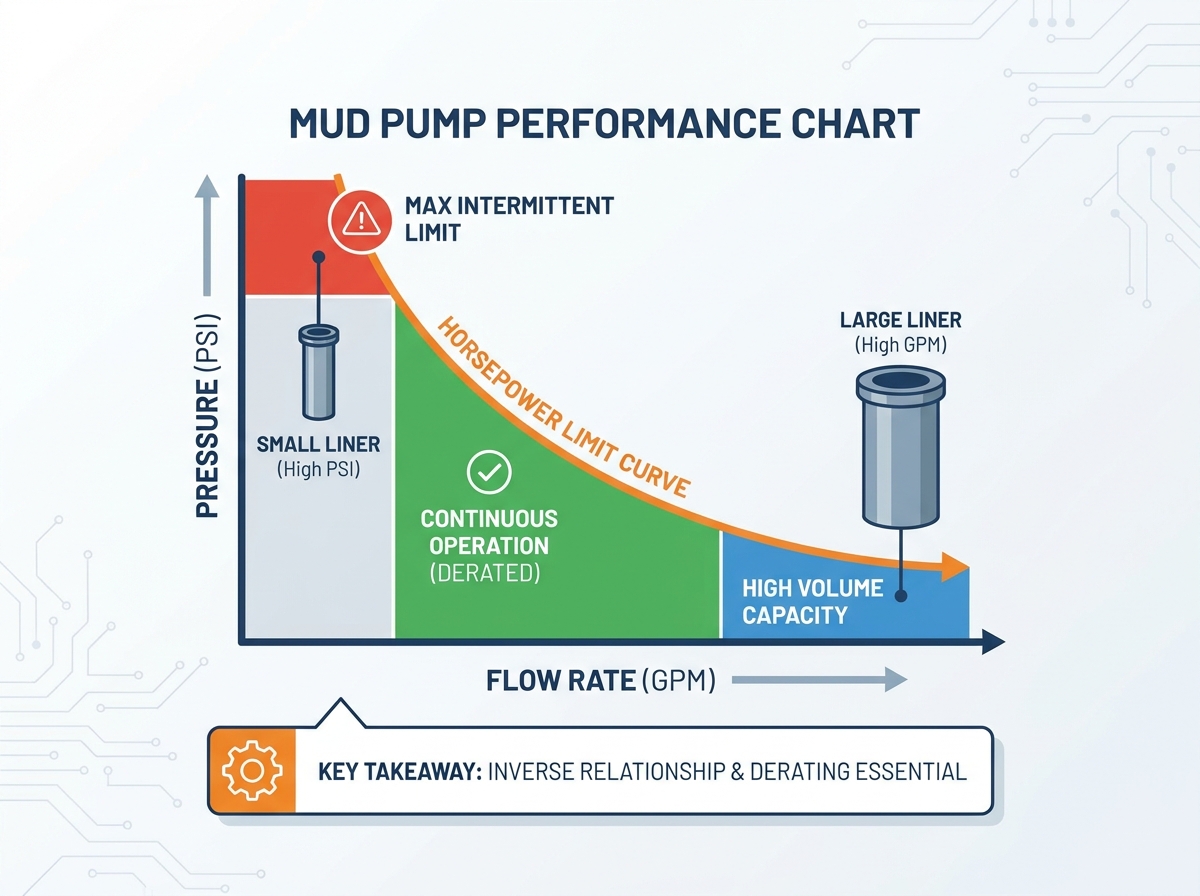
Inverse Relationship: Mud pump pressure and capacity are inversely correlated; increasing flow volume via larger liners fundamentally reduces the maximum allowable operating pressure.
Derating is Mandatory: Nameplate maximums represent intermittent limits; continuous operational sizing requires derating (typically to 70–80% of max capacity) to prevent catastrophic fluid end failure.
Component Lifespan: Operating near maximum pressure limits exponentially accelerates the wear of drilling mud pump parts, impacting Total Cost of Ownership (TCO).
Application-Specific Sizing: Drilling mud pump sizing for deep wells requires precise calculations of annular friction and Bottom Hole Assembly (BHA) pressure losses to determine true Hydraulic Horsepower (HHP) requirements.
You face an absolute trade-off governed by input horsepower. A pump cannot simultaneously deliver its maximum rated pressure and its maximum rated volume. We call this the rigid physics of fluid delivery. Evaluating mud pump pressure and capacity means navigating this exact balance continuously. Increasing flow volume inherently reduces the maximum allowable operating pressure. If you push both limits simultaneously, you risk destroying the prime mover engine.
Theoretical capacity equations often assume 100% volumetric efficiency. Field reality always presents a significantly different picture. Fluid compressibility becomes a major factor at high pressures. Valve delay also reduces actual fluid output per stroke. We standardly benchmark a 90% to 95% volumetric efficiency for modern operations. Relying blindly on theoretical maximums will leave your hydraulic models severely underpowered.
Best Practice: Always apply a 90% efficiency multiplier when calculating true hole-cleaning velocities to ensure a safe operational margin.
These specific metrics directly impact your overall drilling dynamics. Flow rate actively drives the annular velocity needed for efficient cuttings removal. Higher flow safely sweeps the hole clean before cuttings settle. Pressure overcomes system friction and powers your downhole mud motors. You must balance both forces to avoid packing off the drill string. If you prioritize volume excessively, you lose the pressure required for motor efficiency. Your rate of penetration drops drastically. Finding the perfect equilibrium keeps the wellbore stable.
The drilling industry relies on very specific architectural choices for optimal performance. A modern triplex drilling mud pump offers vastly superior metrics compared to older designs. They provide significantly smoother discharge flows and reduce dangerous hydraulic pulsation. They also boast a noticeably lighter weight per delivered horsepower. Rigs transport easier when equipment weighs less.
Table 1: Comparison of Rig Pumping Architectures
Feature | Triplex Architecture | Legacy Duplex Architecture |
|---|---|---|
Action Type | Single-acting pistons | Double-acting pistons |
Pulsation Level | Low (smoother flow) | High (heavy surging) |
Weight to Power Ratio | Excellent (highly mobile) | Poor (extremely heavy) |
Maintenance Speed | Fast component swaps | Slow, complex teardowns |
Stroke length and operational RPM limits define strict mechanical boundaries. Longer strokes fundamentally improve volumetric efficiency. They also prolong consumable life by reducing destructive valve cycle frequencies. Exceeding maximum recommended RPM introduces severe mechanical risks. You invite immediate fluid cavitation and accelerated fluid end fatigue. Cavitation destroys metal surfaces through violent microscopic implosions.
Common Mistake: Running units at maximum RPM continuously to compensate for undersized liners destroys valves within hours.
We must always differentiate mechanical input horsepower from hydraulic output horsepower. Mechanical horsepower represents the raw energy supplied by the prime mover engine. Hydraulic horsepower measures actual drilling capability delivered directly into the fluid. You calculate output power by factoring in mechanical losses through the gear reduction. You never get 100% energy transfer efficiency. Heat and friction consume noticeable amounts of mechanical energy.
Proper drilling mud pump sizing for deep wells requires rigorous engineering constraints. You cannot simply guess the required metrics based on shallow drilling experience. Deep holes amplify every minor hydraulic inefficiency.
System pressure loss calculations demand extreme accuracy and careful modeling. You must calculate cumulative pressure drops across the entire active fluid loop.
Surface equipment restrictions create initial flow bottlenecks.
Drill string internal friction consumes massive amounts of pressure.
Bottom Hole Assembly tools create tight restrictive pathways.
Bit nozzle sizing determines the ultimate pressure drop.
Annular friction against the formation dictates return flow resistance.
You must map these cumulative losses before shortlisting any equipment specifications. Neglecting MWD tool pressure drops often leads to stalled mud motors downhole.
You also must clearly distinguish between continuous and intermittent ratings. Intermittent maximums represent extreme structural limits. They remain viable only for very short-duration emergency events. You might use them briefly for breaking gelled circulation or managing kicks. Continuous ratings serve as the true evaluation metric for deep wells. We require a 20% to 30% safety margin below the absolute structural limit. This derating ensures consistent rig reliability over long drilling programs.
Finally, consider complex drilling fluid density constraints. Pumping heavy mud fundamentally alters the functional pumping capacity. High-density fluids actively increase the mechanical load on the power end. They require significantly more force to move at the same velocity. You must account for mud weight to prevent sudden prime mover stalls. Heavy barite mixtures also accelerate abrasive wear inside the fluid end.
Mechanical thresholds directly limit your daily hydraulic flexibility. Liner and piston configurations dictate your specific operational envelopes on the rig. We deliberately select smaller liners for deeper hole sections. These deep sections require exceptionally high pressure to overcome severe friction. We install larger liners for top-hole sections. Top-hole sections prioritize high fluid volumes to sweep large cuttings safely.
Fluid end metallurgy plays a critical protective role under load. Manufacturers design different block types to handle specific cyclic stress loads.
L-shaped blocks provide distinct fluid routing profiles for easier bleeding.
Two-piece designs offer easier maintenance access in incredibly tight rig spaces.
High-grade forged alloys resist high-cycle fatigue cracking under extreme pressures.
Surface hardening treatments protect against corrosive drilling fluid additives.
You must install appropriately charged pulsation dampeners on every unit. They absorb violent hydraulic shocks exiting the fluid end block. This protection saves your high-pressure discharge piping from catastrophic sudden rupture. Dampeners also shield sensitive downhole steering tools from destructive pressure vibrations. An undercharged dampener basically offers zero system protection.
Operating near maximum limits drastically impacts daily consumable wear rates. Running beyond 85% of structural limits creates exponential wear curves. You will destroy a mud pump and drilling mud pump parts rapidly at this extreme level. Valves, steel seats, and urethane packings degrade fast under maximum stress. Derating protects these internal components and extends their useful life tremendously.
Engineers need a highly structured approach to finalize their equipment selection. Compliance and recognized manufacturing standards form the absolute baseline requirement. Ensure any shortlisted equipment strictly adheres to API Spec 7K. This standard governs safe design criteria for vital drilling equipment worldwide. Non-compliant units introduce unacceptable safety risks on modern multi-well pads. Avoid them entirely.
Evaluate necessary redundancy and rig integration carefully. Determine whether you genuinely need a two-pump or three-pump setup. Deep wells typically require massive continuous hydraulic horsepower. A three-pump configuration lets you rotate units out for routine maintenance safely. You can swap expendables without halting your active drilling operations. This setup maximizes continuous rig uptime and protects project schedules.
Evaluate capital expenditure against component availability in your region. Focus heavily on the upfront cost alongside standard parts interchangeability. A cheaper initial purchase might force you to buy proprietary valves. Sourcing obscure replacements inflates operational budgets severely over time. Standardized components guarantee quick field-serviceability when emergencies strike. Always verify aftermarket support capabilities before signing a final procurement contract. You need parts available immediately when a seal fails at midnight.
Evaluating hydraulic equipment demands strict attention to continuous performance capabilities rather than theoretical limits. Making smart procurement choices requires aligning mechanical strength with precise downhole parameters.
Select equipment based solely on continuous horsepower ratings, never intermittent maximums.
Derating your equipment ensures long-term reliability and minimizes destructive rig downtime.
Component standardization matters just as much as raw hydraulic output during field operations.
Properly size your liners to match specific well depths and fluid volume demands.
As an actionable next step, finalize your detailed hydraulic modeling early. Determine your exact standpipe pressure and required annular velocity for the deepest section. Once you establish these baseline numbers, request manufacturer performance curves to complete your final procurement evaluation confidently.
A: You determine liner size using the manufacturer's operational performance chart. Match your required gallons per minute against the maximum allowable standpipe pressure. You must ensure this specific combination never exceeds the maximum input horsepower limits. Smaller liners securely handle high pressures for deep sections. Larger liners deliver massive volumes for sweeping shallow intervals.
A: Mechanical horsepower represents raw energy supplied by the prime mover engine. Hydraulic horsepower defines the actual energy delivered directly into the drilling fluid. Hydraulic output always measures lower than mechanical input. Mechanical friction and volumetric efficiency losses naturally consume a noticeable portion of the prime mover's raw energy.
A: Operating at absolute nameplate limits continuously causes rapid internal metal fatigue. Fluid end modules and internal expendables fail prematurely under constant peak stress. Derating establishes a critically necessary safety factor. Limiting continuous output to roughly 80% drastically improves structural reliability. This practice safely minimizes non-productive time across demanding drilling programs.
A: Triplex configurations utilize three smaller single-acting pistons instead of two large double-acting ones. This architecture permits much shorter strokes and higher operational RPMs safely. It produces a remarkably smooth discharge flow. The smaller bore sizes allow engineers to forge stronger, highly compact fluid end blocks capable of containing extreme pressures.


